Technical explanation
What does the .dwg extension mean?
The .dwg extension is the standard file extension for DWG drawing files. The format is closely associated with AutoCAD and has been part of the Autodesk ecosystem since the early history of the product; Autodesk dates DWG to the first AutoCAD release in 1982, while the Library of Congress notes earlier roots in the late 1970s.
DWG is a proprietary (closed-source) binary file format used for storing 2D and 3D drawings, model data, and metadata. Its binary encoding keeps file sizes relatively compact compared to text-based alternatives, which makes it practical for storing large design files, though it also means you need compatible software to open them.

What does a DWG file contain?
DWG files can store much more than simple linework. Autodesk describes DWG as capable of holding 2D and 3D geometry as well as associated drawing content, while the Library of Congress characterizes the format as storing and describing 2D and 3D design data and metadata. In practical terms, a DWG file may contain geometry, annotations, dimensions, object properties, and other drawing-related information needed to continue work inside a CAD environment.
Is DWG the same as DXF?
No. DWG and DXF are related, but they are not the same format. Autodesk describes DWG as its proprietary format, while DXF is an open file format standard intended for data interchange. Both were introduced alongside AutoCAD in 1982, but they serve different purposes.
DWG's binary encoding generally produces smaller files than DXF's text-based encoding, which is one reason DWG is often preferred as the working format and DXF as the exchange format. Unlike DWG, DXF stores data as plain text, so any application can parse it without reverse-engineering a binary structure.
What programs can open DWG files?
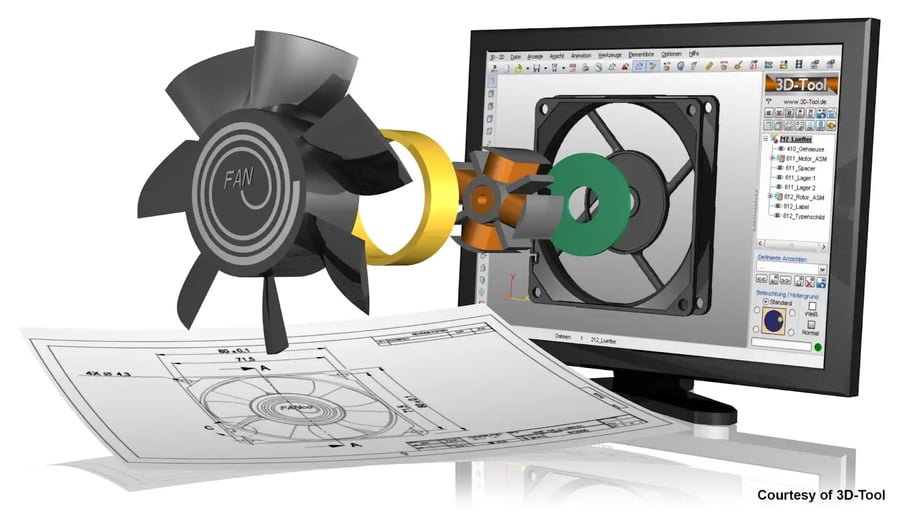
The most direct way to open DWG files is with Autodesk tools such as AutoCAD, DWG TrueView, and Autodesk's web-based viewers. A broader ecosystem of compatible applications also exists. The Open Design Alliance publishes a DWG specification and states that its technology can read and write DWG files with strong AutoCAD compatibility, which is why many third-party editors and viewers can work with the format.
Some software programs that can open DWG files:
- Autodesk AutoCAD
- Autodesk DWG TrueView
- IntelliCAD
- Open Design Alliance applications
- Caddie
- IMSI TurboCAD
- CorelCAD
- Dassault Systemes DraftSight
- Adobe Illustrator
- GRAPHISOFT ArchiCAD
- Canvas X
- CADSoftTools ABViewer
- progeCAD iCADMac
- Bricsys BricsCAD
Can you view a DWG file with non-Autodesk applications?
Because DWG is proprietary, non-Autodesk CAD applications cannot open the file natively the way AutoCAD does. In most cases, the application must convert or translate the DWG data on import. Depending on how that translation is implemented, this can introduce issues such as slower import times, version-control problems, errors in model data, or loss of metadata. The quality of the result depends heavily on the importing application's DWG support.
Applications and industry use cases
DWG is used across architecture, engineering, manufacturing, drafting, and design workflows wherever teams need a practical working format for 2D drawings or 3D design data. Autodesk describes DWG as a leading industry standard for CAD data exchange among drafters, architects, and engineers, and the format's ability to carry both geometry and related metadata is a major reason it remains central to project collaboration.
For software developers, DWG matters in import/export pipelines, viewers, markup tools, drafting applications, and interoperability workflows where users expect direct access to AutoCAD-originated data.
Challenges or common pitfalls
One common issue is software compatibility. Because DWG is proprietary and versioned, older software or partial implementations may not open newer files correctly, or may not preserve all data during import and export. This is a recurring concern in real workflows and one reason Autodesk provides version-conversion tools such as DWG TrueView.
Another pitfall is assuming that non-native access to DWG is always trouble-free. Compatible applications exist, but non-native workflows can still run into translation issues, incomplete metadata transfer, or feature mismatches depending on how the application implements DWG support. The existence of third-party compatibility layers and published reverse-engineered specifications, rather than one fully open canonical implementation, reflects this complexity.
Large or corrupted files also create practical problems. DWG often serves as the main working file for complex design projects, so file size, model complexity, and save/export integrity can all affect whether a file opens quickly and reliably. Autodesk's own support ecosystem around DWG viewers, file corruption recovery, and file associations reflects how operational these issues can be in day-to-day use.
How Spatial helps
Our 3D InterOp SDK reads DXF/DWG files and writes DXF/DWG output as part of a broader CAD translation stack. 3D InterOp is designed to exchange visualization data, exact B-rep geometry, and metadata across CAD formats, so DWG handling is not an isolated feature but part of the same architecture that handles 30+ other formats.
On the read side, 3D InterOp imports both 2D drawing content and 3D model data from DWG files. This includes importing 2D drafting sheets that your application can use as reference drawings alongside 3D geometry. For applications in manufacturing, inspection, or design review, having access to the 2D drawing view together with the 3D model is often a practical requirement.
3D InterOp applies automatic healing during translation. DWG files that have passed through multiple software environments or version-conversions can arrive with geometry and topology problems. Our healing pipeline addresses these during import:
- Topology repair: removing duplicate and overlapping vertices, splitting edges with large discontinuities, and fixing loop errors so the result conforms to the rules of your target modeling kernel.
- Geometry refinement: reconstructing self-intersecting or irregular curve and surface geometry. The healing process does not alter the intended shape of the original model.
- Stitching and gap closure: extending adjoining surfaces and recomputing intersections to close gaps between adjacent faces, producing topologically valid solid models ready for downstream operations.
This matters because geometry defects that slip through translation cause failures later, whether in meshing, simulation, manufacturing prep, or even just viewing. Fixing these problems at import time means your users do not have to deal with them manually.
3D InterOp generates native geometry for ACIS, CGM, and Parasolid kernels, so imported DWG data can behave as if it were created natively in your application. That is what makes it possible to run downstream operations (modeling queries, Boolean operations, meshing) on imported geometry without additional conversion steps.
Our selective import API lets your application load only what it needs. You can import product structure, tessellated geometry, exact geometry, or manufacturing information independently rather than pulling in the entire file. For DWG workflows where you may only need the 2D drawing sheet or only the 3D geometry, this gives you control over memory and performance.
We also export 2D drawing visualization data as DXF/DWG files, so your application can round-trip data back out to users who work in AutoCAD-based environments.
3D InterOp reads and writes more than 30 CAD, BIM, mesh, and visualization formats, so DWG handling can be one step in a larger pipeline that includes native CAD formats like CATIA, NX, SOLIDWORKS, Creo, and Inventor alongside neutral formats like STEP and IGES.
Over 300 companies have used 3D InterOp across more than 20 years.
You can request an evaluation here.

-1.webp)

















.png?width=450&name=AdobeStock_188705270%20(2).png)