
Convert CATIA V4 to DAE in your application
3D InterOp is a CAD interoperability SDK that lets your software read CATIA V4 files and write DAE, generating the DAE mesh from the geometry it reads, with tessellation settings your application controls, without a CATIA license.
Spatial does not offer an online converter or a desktop conversion app. 3D InterOp is a component that software vendors embed in their own products.
- Reads CATIA V4 · Writes COLLADA
- Exact geometry → triangle mesh
- C++ / C# APIs
CATIA V4 to DAE at a glance
CATIA V4 stores exact geometry; COLLADA stores triangles. The translation is a tessellation, and the settings you choose decide how close the mesh stays to the original.
| CATIA V4 (source) | COLLADA (target) | |
|---|---|---|
| Full name | CATIA Version 4 | COLLADA Digital Asset Exchange |
| Standard / owner | Dassault Systèmes | Khronos Group, ISO/PAS 17506 |
| File extensions | .model, .exp, .session | .dae, .zae |
| Geometry | Exact B-Rep | Triangle mesh |
| Assemblies / structure | Yes (written as parts only) | Yes: scene hierarchy |
| 3D InterOp support | Read and write | Read and write |
What's preserved, what changes
Here is what your application can expect to carry across from CATIA V4 to COLLADA.
-
Changes
Geometry is tessellatedThe exact CATIA V4 B-Rep is replaced by a triangle mesh, generated by 3D InterOp from the exact geometry it reads. Accuracy depends on the tessellation settings your application uses.
Why software vendors add CATIA V4 to DAE conversion
Lightweight review
COLLADA carries tessellated geometry that opens much faster than the full CAD model, so design reviews and digital mockups stay responsive.
Sharing outside engineering
Marketing, training and sales teams rarely have CAD software. A COLLADA file gives them the shape in a format their tools can open.
Easier handling of large assemblies
Without exact surfaces and feature data, COLLADA files are easier to transfer and display, even for large assemblies.
Things to check before you ship
- Written DAE versions: COLLADA 1.4.1 (.dae).
- The DAE writer is available through the UConnect interface only.
- Supported CATIA V4 input: CATIA 4.1.9 to 4.2.4 (.model, .exp, .session).
- Test tessellation settings on your heaviest parts: finer meshes mean larger files.
- Validate a sample of translated files in the target system your users actually work with.
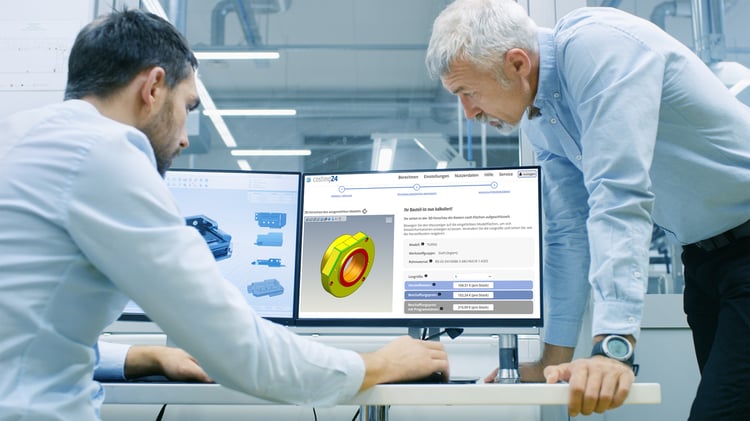

Working with Spatial was a real milestone for us: Thanks to the powerful 3DInterOp library, we were able to successfully bring our complex CAD-based solutions to the cloud while remaining flexible to meet individual customer requirements. For us, Spatial is not just a technology partner, but a true enabler of our product strategy.
Dr. Arno Michelis, Founder, Simus Systems
Read the Case StudyAbout the formats
-
Source format
What is a CATIA V4 (.model) file?
CATIA V4 is the legacy generation of Dassault Systèmes’ CATIA, whose models are mostly stored in .model files. Many aerospace and automotive archives still hold CATIA V4 data.
-
Target format
What is a DAE (COLLADA) file?
COLLADA (.dae) is an XML-based open format from the Khronos Group for exchanging 3D scenes: meshes, materials, cameras and lights. It is common in visualization and AR/VR pipelines.
Frequently asked questions
3D InterOp tessellates the geometry it reads from CATIA V4 when it writes DAE. Your application sets the tolerances, so it controls the trade-off between accuracy and file size.
The DAE writer is available through the 3D InterOp UConnect interface.
No. 3D InterOp reads CATIA V4 files directly, without CATIA or a CATIA license on the machine.
3D InterOp reads CATIA 4.1.9 to 4.2.4 (.model, .exp, .session).
3D InterOp writes COLLADA 1.4.1 (.dae).
Yes. 3D InterOp reads and writes both formats, so DAE to CATIA V4 is supported too.
-
Building software that needs to convert CATIA V4 to DAE?
3D InterOp is an SDK that lets your application read CATIA V4 and write COLLADA alongside 30+ CAD and BIM formats.