What is being converted?
A CATPart file stores a part model in the CATIA V5 ecosystem and contains 3D geometric and structural data for a single designed component. In CAD workflows, it is typically the exact part definition used before the model is reused in assembly, simulation, manufacturing, or data-exchange steps.
An STL file is very different. It stores the surface of a model as a set of triangular facets and is widely used for 3D printing and rapid prototyping. STL focuses on shape only rather than full CAD semantics, and it does not normally carry color or texture information.
How does the conversion work?
In technical terms, CATPART-to-STL conversion is a move from an exact CAD representation to a tessellated mesh representation. The conversion workflow reads the native CATPart geometry, approximates the visible surfaces with triangles, and writes the result as an STL file. That is why the quality of the output depends heavily on tessellation quality rather than only on the source model itself.
3D Systems notes that STL quality is affected by settings such as Chord Tolerance and Angular Control. In practice, tighter tessellation settings create more triangles and usually improve geometric fidelity, but they also increase file size and processing cost.
What is preserved, and what is lost?
The goal of the conversion is to preserve the part's usable shape for downstream mesh workflows. However, the resulting STL is not the same kind of model as the original CATPart: it is a triangle-based approximation, not a native part file with the same exact geometry definition, structure, and associated CAD intelligence.
That distinction matters because an STL file may be ideal for printing or lightweight mesh processing while being much less suitable for exact CAD editing, feature-level modification, or metadata-rich engineering workflows.
Typical workflow after conversion
In many applications, conversion is only one step. STL data often needs validation or repair before it is ready for downstream use. Spatial's STL repair guidance lists the following as part of a typical repair workflow:
- Misaligned edges
- Holes in the model
- Floating parts
- Overlaps
- Double faces
- Open edges
- Remeshing needs
Applications and industry use cases
CATPART-to-STL conversion is most commonly used when a part designed in CATIA V5 needs to move into 3D printing, rapid prototyping, or another mesh-centered workflow. It is useful when downstream systems need a printable or tessellated representation rather than the original native CAD part file.
It is also relevant for software developers building:
- Import/export tools
- Manufacturing preparation pipelines
- Mesh processing applications
- Additive manufacturing software
3D InterOp handles the CAD import side of these workflows, while CGM Polyhedra handles healing and preparing STL-like data for printing.
Challenges or common pitfalls
A common mistake is to assume that converting CATPART to STL is a neutral one-to-one translation. It is not. The workflow changes the representation from native CAD part data to a triangle mesh, so downstream users should not expect the STL to behave like the original CATPart.
Another pitfall is poor tessellation settings. If the STL mesh is too coarse, curved or detailed surfaces may be represented poorly; if it is too dense, file sizes and processing overhead can become unnecessarily large. 3D Systems specifically points to chord tolerance and angular control as important export parameters for STL quality.
Mesh quality is another frequent issue. Spatial documents common STL defects that can break printing or downstream mesh processing if they are not repaired:
- Holes
- Overlaps
- Floating parts
- Misaligned edges
- Open boundaries
How Spatial helps
3D InterOp converts CATPart files to STL and applies automatic healing and repair during the translation to reduce errors before the mesh ever reaches a downstream tool. It reads and writes over 30 CAD, mesh, and visualization formats.
For CATIA data specifically, 3D InterOp uses the CGM kernel and native APIs supplied by Dassault Systèmes to read and write CATPart and CATProduct files — no CATIA license required. Its Selective Import API lets developers pull in only the data they need:
- Product structure
- Tessellated geometry
- Exact geometry
- Manufacturing information (PMI)
Because 3D InterOp integrates natively with the 3D ACIS Modeler, CGM Modeler, and Parasolid, the translated geometry arrives ready for downstream modeling operations with no additional conversion step.
Once the data is translated, CGM Polyhedra picks up the mesh-level work. It gives developers APIs to check, heal, and modify polyhedral geometry directly — filling holes created by missing triangles, correcting flipped normals, closing cracks and gaps, correcting non-manifold arrangements, and cleaning overlapping or improperly intersecting triangles. Beyond repair, CGM Polyhedra supports full modeling operations on mesh data: Booleans, offsets, decimation, slicing, and clash detection. For additive manufacturing preparation, it also provides wall thickness analysis, hollowing, automatic support generation (wire, volume, and cone types), orientation optimization, 2D/2.5D/3D nesting, and multi-planar slicing for toolpath planning.
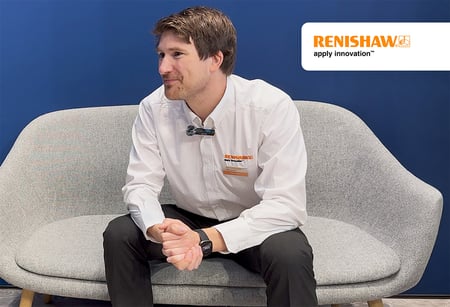
A real-world example of these SDKs working together: Renishaw, a manufacturer of industrial metal 3D printers, integrated 3D InterOp and the 3D ACIS Modeler with CGM Polyhedra into their QuantAM build-preparation software. They wanted to move away from an STL-only import pipeline and bring in native CAD data directly. The result was fewer transcription errors, far less time spent healing STL files, and the ability to feed corrected geometry back upstream to design teams. As Stephen Anderson, Renishaw's Director of Group Software, put it: "Our collaboration with Spatial now allows us to not only perform high-quality healing on STL files but, more importantly, to import various CAD formats directly."
For developers building the visualization layer, HOOPS Visualize renders the 3D scene in the application — displaying both the imported CAD geometry and the prepared mesh data with high-performance graphics across desktop and mobile platforms.

-1.webp)














.png?width=450&name=AdobeStock_188705270%20(2).png)