What is faceting?
Exact CAD models are typically defined with precise parametric geometry and topology, such as B-rep faces, edges, and trimming information. Faceting replaces that exact representation with a mesh made of many connected polygons, so the model can be handled by graphics hardware and other mesh-based pipelines more efficiently.
How does it work?
A faceting algorithm samples the original geometry and generates polygons that stay within specified error limits. In practical CAD systems, output quality is commonly controlled by a few tolerances:
| Tolerance |
What it controls |
| Maximum sag / chord error |
How far a facet may deviate from the true surface |
| Maximum polygon length |
The largest allowed edge length on a facet |
| Maximum normal angle |
The largest allowed angle between neighboring polygon normals |
These parameters let developers trade off geometric fidelity against facet count and processing cost.
Why is faceting important?
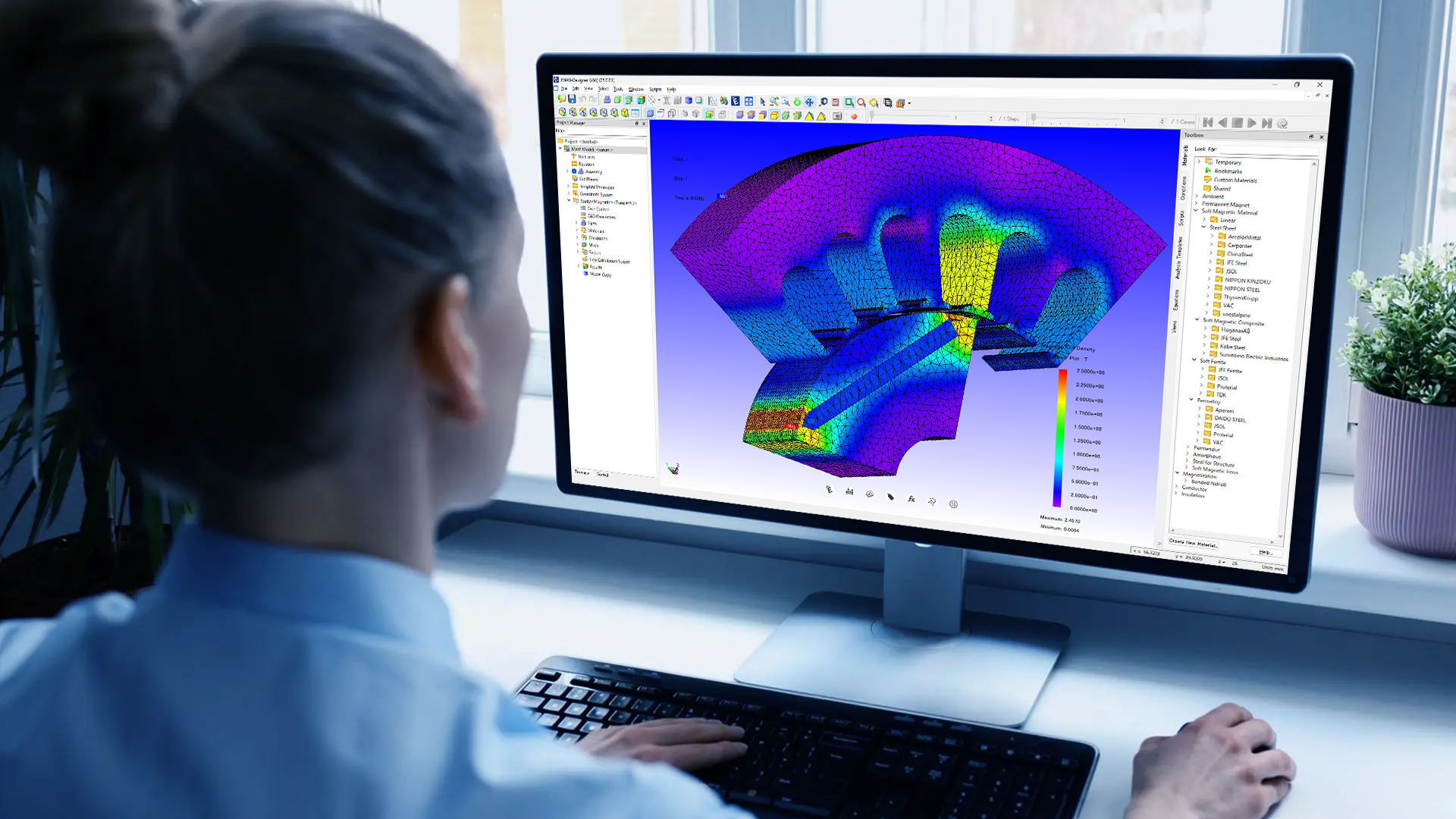
Faceting is a fundamental preprocessing step for visualization, numerical simulation, and digital manufacturing. Mesh-based representations are easier to render interactively, easier to pass into many analysis workflows, and easier to export into lightweight or manufacturing-oriented formats.
What is gained, and what is lost?
The main gain is performance: a faceted model is usually much easier to display and process than the original exact CAD definition. The tradeoff is that discretization can discard analytic surface structure and exact topological information, replacing intrinsic geometric boundaries with sampling-dependent approximations. That is why a faceted model is often ideal for viewing or simulation preprocessing, but not equivalent to the original exact CAD model.
Applications and Industry Use Cases
Faceting is widely used in interactive 3D visualization, where GPUs render polygonal meshes rather than exact CAD surfaces. It is also central to simulation preprocessing, where CAD geometry is discretized into mesh-based representations, and to digital manufacturing workflows that depend on tessellated geometry.
In engineering software, faceting is especially important when applications must handle large assemblies, lightweight review models, mesh-based analysis, or formats such as STL that represent geometry through facets rather than exact surfaces. It is a key bridge between precise CAD authoring and downstream workflows that prioritize speed, portability, or mesh-based computation.
Challenges or Common Pitfalls
A common mistake is to assume that more facets are always better. Finer faceting usually improves visual accuracy, but it also increases memory use, file size, and processing time. In practice, the right faceting settings depend on the downstream task, not just on visual smoothness.
Another pitfall is poor topological consistency. If neighboring CAD faces are faceted independently, the resulting mesh can contain gaps or mismatched boundaries. Research on watertight faceted CAD models shows that these defects can prevent reliable downstream use and may require sealing or repair to make the mesh consistent.
Developers should also be careful not to confuse a faceted model with exact engineering truth. Because tessellation can introduce sampling artifacts, narrow features, high-curvature areas, or small topological details may be represented imperfectly unless tolerances and repair steps are handled carefully.
How Spatial Helps
Spatial provides two technologies for applications built around faceted or hybrid geometry workflows.
CGM Polyhedra handles polygonal and polyhedral modeling. It exposes APIs to check, heal, modify, and query polyhedral models, and it cleans up the kinds of mesh defects that block downstream use:
- Covers holes and stitches facet edges to make a mesh watertight
- Corrects facet orientations
- Eliminates sliver geometries
- Runs operations such as decimation and slicing
3D Data Prep reduces facet count and model complexity before downstream use. It cuts the amount of detail and the number of facets in a model, which makes later rendering, analysis, and translation faster and lighter.

-1.webp)














.png?width=450&name=AdobeStock_188705270%20(2).png)